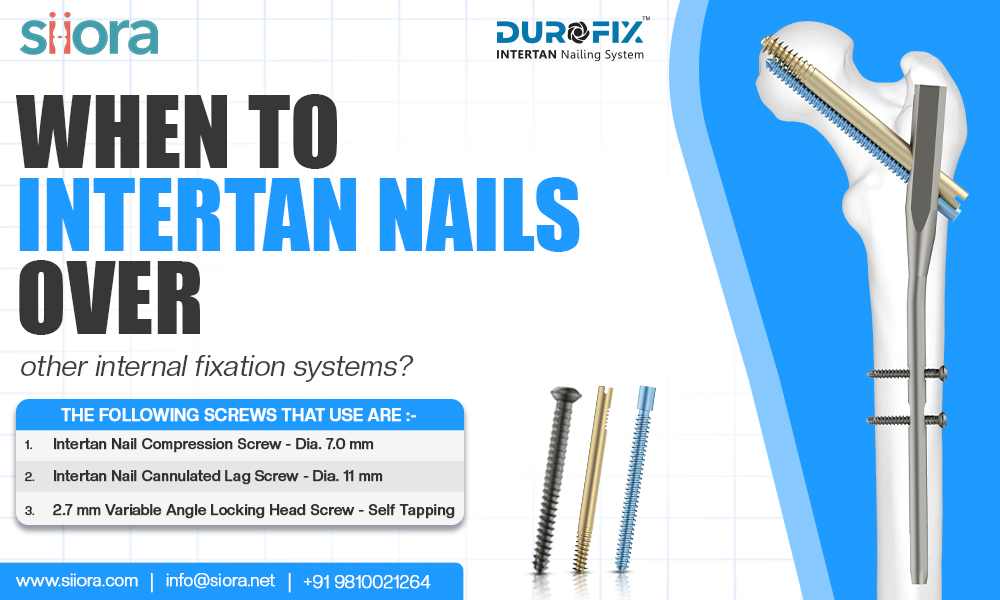
Hip fractures, especially those occurring in the intertrochanteric region, are quite common in orthopedic practice. They are frequently seen in elderly patients after a simple fall, though younger patients may also experience them after high-energy trauma. The main goal of treatment is to stabilize the fracture so the patient can regain mobility as early as possible. Several internal fixation options are available today, including dynamic hip screws, plates, and different types of intramedullary nails. Among these, Intertan nails have gained attention because of the stability they can offer in certain fracture patterns.
What Makes Intertan Nails Different?
Intertan nails are a type of intramedullary fixation device designed mainly for intertrochanteric femur fractures. What makes them different from some traditional systems is their dual integrated screw design. Instead of relying on a single lag screw, this system uses two screws that work together to control the rotation of the femoral head. This small design change can make a big difference when dealing with unstable fractures.
Because the implant sits inside the medullary canal, it also aligns with the natural weight-bearing axis of the femur. This allows better load sharing between the implant and the bone, which is important for proper healing.
Situations Where Intertan Nails Are Often Preferred
Orthopedic surgeons may consider Intertan nails when treating unstable intertrochanteric fractures. These fractures can be difficult to manage with traditional plating systems because the bone fragments tend to shift or collapse during weight bearing.
Another situation where Intertan nails are useful is when rotational stability is a concern. In some fractures, the femoral head may rotate even after fixation. The dual screw mechanism of the Intertan system helps reduce this risk and keeps the fracture alignment more secure.
Intertan nails may also be chosen for fractures that extend toward the subtrochanteric region. Since the implant runs through the medullary canal, it can provide stronger internal support compared to some extramedullary fixation methods.
Advantages Compared to Some Other Fixation Systems
One practical advantage of intramedullary systems like Intertan nails is the minimally invasive approach. The surgery usually requires smaller incisions compared to plating procedures. Less disruption of soft tissue can support quicker recovery and reduce surgical trauma.
Another benefit is improved stability in certain fracture patterns. The dual screw configuration helps control both compression and rotation, which may lower the chances of complications such as implant failure or fracture displacement.
Patients may also benefit from earlier mobilization. Stable fixation allows surgeons to begin rehabilitation sooner, which is particularly important for elderly patients who may face complications from prolonged bed rest.
Considering the Patient and Fracture Type
Even though Intertan nails offer several advantages, they are not automatically the best choice for every hip fracture. The decision always depends on factors such as fracture pattern, bone quality, patient age, and overall health condition.
In stable fracture patterns, other fixation systems may still work well and remain widely used. Surgeons usually evaluate imaging findings and clinical factors before deciding which implant will provide the most reliable outcome.
Final Thoughts
Intertan nails have become an important option in the treatment of certain hip fractures, particularly unstable intertrochanteric injuries. Their design helps improve rotational stability and supports effective load sharing within the femur. While other fixation systems continue to play a role, Intertan nails are often chosen when surgeons need additional stability and reliable fixation. Careful patient assessment and proper surgical technique remain the key factors in achieving successful fracture healing.
If you want to explore the latest collection of trauma implants, book your visit to the FIME Show 2026.
 siiora surgicals pvt. ltd